 Aizaz
Aizaz

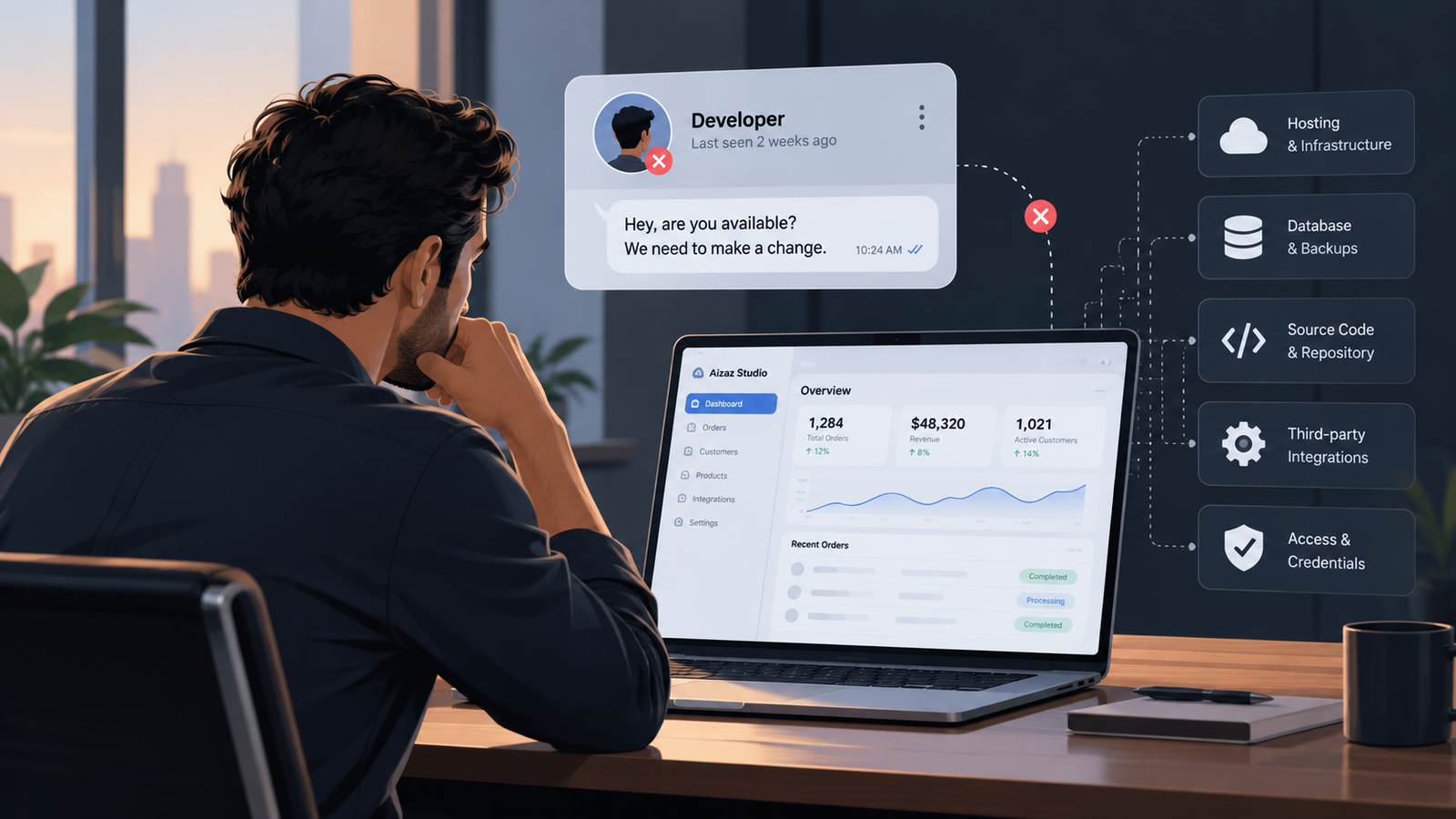
If your developer disappears tomorrow, your software will probably keep working.
The real problem begins when something breaks, you need a new feature, or an important integration stops working.
And suddenly, nobody knows how to fix it.
This is something I think business owners should consider before hiring someone to build custom software.
Not because developers can't be trusted. People change jobs, move on to other projects, or become unavailable. That's normal.
The question is whether your business can continue without the person who originally built its software.
You paid for the software. But how much control do you actually have?
Imagine you've spent months developing an application for your business.
Your employees use it every day. Customer information, orders, payments, and internal workflows all depend on it.
Now imagine you need another developer to make a change.
They ask you a few questions.
Where is the source code?
Who has access to the hosting account?
How is the application deployed?
Where are the database backups?
And you realize you don't know the answers.
You might have paid for the entire project, but practically speaking, you're still dependent on the original developer.
That's a risk worth addressing before anything goes wrong.
Having the source code isn't enough
One misconception is that receiving the source code means you're completely covered.
It's an important starting point, but software is more than a collection of files.
A working application might depend on cloud infrastructure, databases, payment providers, external APIs, background services, and configuration that isn't included in the code repository.
Another developer might understand the programming language perfectly and still struggle to get the application running.
That's why a proper handover matters.
It should give the next developer enough information to understand the system, operate it safely, and continue development without having to figure out everything from scratch.
Five things your business should have access to
You don't need to understand every technical detail yourself.
But you should know where these things are and who controls them.
1. Source code and ownership
Your business should have access to the repository, with clear contractual rights to use, modify, and maintain the software.
2. Hosting and infrastructure
Know where your application runs and who controls the hosting, domain, and important service accounts. Ideally, critical accounts should be under business-controlled administration.
3. Database and backups
Know where business data is stored, how backups are managed, and whether someone has tested the recovery process.
4. Documentation
There should be enough documentation for another developer to understand the application's main components, integrations, and deployment process.
5. Credentials and access
Important access should be managed securely through business-controlled accounts or approved credential-management systems. Passwords and API keys shouldn't simply be scattered across personal messages.
None of this guarantees that changing developers will be effortless.
But it can make the difference between an organized handover and weeks of unnecessary investigation.
Ask for a handover before you need one
Here's one question I'd encourage every business owner to ask their development team:
"If we had to bring in another developer next month, what would they need to continue working on this application?"
You don't need to wait until the project is finished to have that conversation.
Discuss ownership, documentation, deployment, backups, and ongoing maintenance while the software is being built.
A good software delivery and handover process should account for documentation, access, and maintenance before the project is considered complete. And if your developer has already left and the application is difficult to maintain, start by assessing what exists rather than immediately rebuilding everything.
Our guide on rescuing an existing software project covers that situation in more detail.
Your business shouldn't depend on one person's availability
I'm not suggesting that every business needs an entire engineering department.
One good developer can build something incredibly valuable.
But if your operations depend on that software, your business needs a way to maintain it even when the original developer is no longer available.
Because building software isn't just about making it work today.
It's about making sure the business can keep using it tomorrow, regardless of who originally built it.