 Aizaz
Aizaz

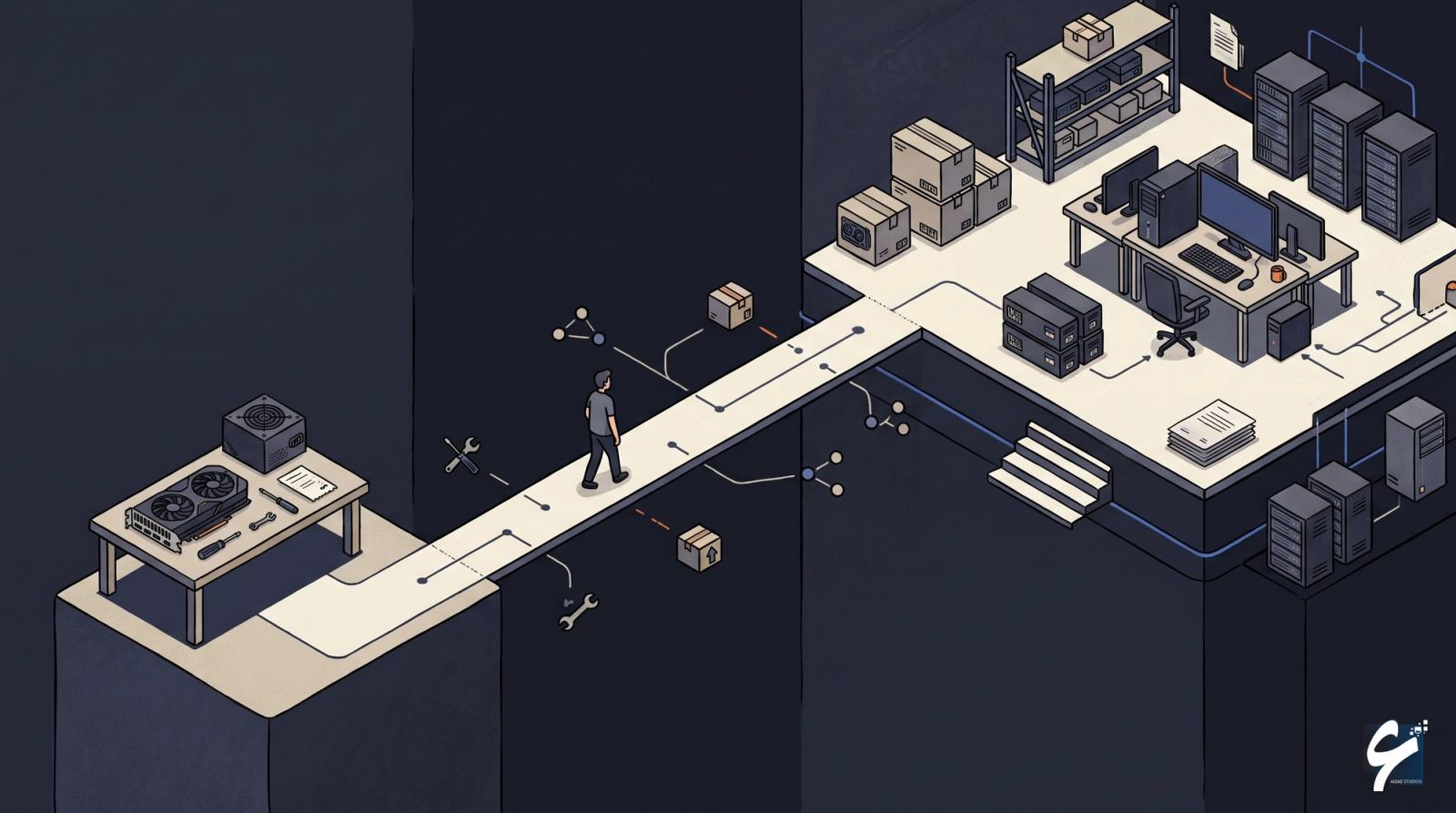
I’ve spent a lot of time lately trying to figure out how to sell software services.
Cold email. Content. SEO. LinkedIn. Recently funded companies. Who to contact. What problem to lead with. How much technical context I need before starting a conversation.
The strange part is that selling isn’t completely new to me.
Alongside building Aizaz Studio, I still work around the computer hardware market in Karachi. I’ve sold graphics cards, put together systems, dealt with resellers and suppliers, sourced difficult to find parts, helped customers troubleshoot their PCs, and spent enough time in the market to understand how a physical product moves from one person to another.
But selling a software service feels completely different.
I think one customer helped me understand why.
A few years ago, fairly early in my hardware journey, I was selling some GPUs that had previously been used for mining.
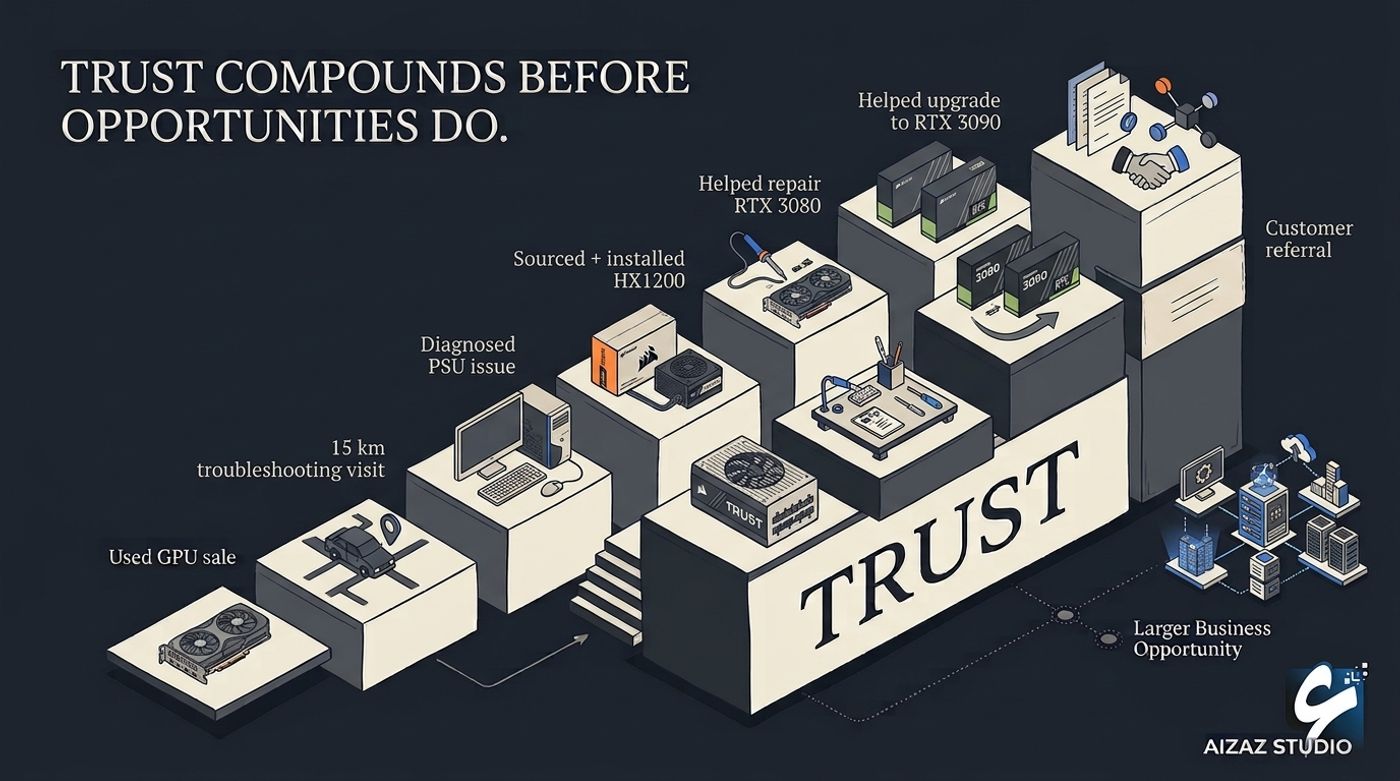
A customer found me through OLX and came to buy an RTX 3080.
I sold it for around PKR 115,000, roughly $410. I knew what the card had been used for, I wanted to keep cash moving, and I wasn’t interested in squeezing every possible rupee out of the deal.
That could easily have been the end of it.
A few months later, he called me because his PC had started randomly restarting.
He lived roughly 15 kilometers away from me, one way.
I went over to his house and spent a few hours diagnosing the system. Eventually, I traced the problem back to the power supply.
I managed to find him a box packed Corsair HX1200, which wasn’t particularly easy to source locally at the time. I delivered it, installed it, tested the system and stayed until I was comfortable that everything was working properly.
Some time later, the RTX 3080 itself died.
We sent it to a repair shop, got it repaired, and things went back to normal.
Then he contacted me again.
This time he wasn’t really interested in repairing or troubleshooting anymore. He wanted to upgrade.
I helped him sell the repaired RTX 3080 for around PKR 120,000, roughly $430, found him an MSI Suprim X RTX 3090, took it to his house late at night, installed it and checked the system again.
There were plenty of smaller questions and bits of help between those bigger moments too.
None of this was part of some deliberate retention strategy.
I wasn’t calculating lifetime value or thinking about funnels.
My thinking was much simpler:
This person trusts me. I know how to help. So I’ll help.
Then the relationship became much more interesting.
A small sale turned into a much bigger opportunity
Eventually, the customer introduced me to one of his childhood friends.
His friend was involved in fulfilling a large government-related hardware procurement requirement.
My customer essentially told him:
“Ask him to handle it. I trust him.”
Suddenly I was looking at something completely different from selling a single graphics card.
The requirement was for roughly 19 high-end systems, including several machines with RTX 5090s, Core i9-14900K-class processors.
The total requirement was around PKR 11.8 million — roughly $42,000.
I want to be precise about my role here.
I did not win a government contract myself. I never dealt directly with the government department receiving the equipment, and I never met the person ultimately responsible on that side.
I was helping the contractor figure out the sourcing and fulfillment side of the order.
And that turned out to be much harder than simply finding the parts.
When I started talking to people in the market, a lot of vendors were perfectly comfortable saying:
“Yes, we can arrange it.”
Then the payment terms came up.
Government procurement can involve delayed payments, sometimes stretching one to three months, rather than the upfront payment that smaller businesses and local vendors are usually comfortable working with.
Suddenly:
“We can arrange it.”
became:
“We can arrange it if you bring the money first.”
That was the actual bottleneck.
Not demand.
Not necessarily supply.
Working capital.
There was a large transaction sitting in front of us, but having access to the opportunity didn’t automatically mean we had the financial structure required to capture all of it.
I spoke to different vendors. We explored importing certain components ourselves. I asked around the network I had slowly built through being in the market.
Eventually, through a combination of those relationships, we were able to help get the requirement fulfilled.
I made some money from it.
Not an extraordinary amount.
Looking back, though, the money wasn’t the most valuable part of the experience.
The interesting part was how the opportunity reached me in the first place.
There was no cold outreach campaign.
No personal brand.
No authority-building strategy.
No clever lead magnet.
One person bought a used RTX 3080 from me.
Then something broke, and I helped.
Then something else happened, and I helped again.
Then he wanted to upgrade, and I helped again.
Eventually, somebody around him had a problem far larger than anything we had worked on together before.
And my name came up.
I didn’t really understand it at the time, but I wasn’t only selling hardware anymore.
I was selling certainty.
He knew that if something went wrong, I would probably show up and try to solve it.
That is much harder to communicate when you’re selling a service to someone who has never worked with you before.
Selling something that doesn’t exist yet
That experience keeps coming back to me while building Aizaz Studio.
If somebody wants an RTX 5090, they already understand roughly what they’re buying.
They can visit five stores.
One has better pricing.
Another has stock immediately.
One offers a better warranty.
Maybe they already know a reseller they trust.
Maybe they visit ten shops and buy from the eleventh.
There can be thousands of businesses selling essentially the same products because the buyer already understands the category.
The product exists before the transaction.
Software services are different.
A company might come to you saying they need an AI agent.
Maybe they do.
Maybe what they actually need is an integration between two systems.
Maybe an existing SaaS product solves almost everything.
Maybe some custom software is justified.
Or maybe the process happens so infrequently that they should leave it manual.
And even when custom software is the right answer, the customer can’t inspect the finished product before buying it.
They are buying a promise about something that doesn’t exist yet.
That makes trust much more important.
It also makes differentiation much harder.
Starting a software agency is incredibly easy.
Make a website.
Write:
Custom Software. AI Automation. SaaS Development.
Add some animations.
And now you look remarkably similar to thousands of other companies.
AI has made software easier to build, but it hasn’t made the underlying product simpler. Modern AI tools can help someone create interfaces, APIs, database logic and complete features surprisingly quickly.
That doesn’t mean strong engineering stopped mattering.
I think the difference has moved somewhere less visible.
It’s increasingly in questions like:
Should we build this at all?
What happens when it breaks?
What becomes expensive to change six months from now?
Is this abstraction actually necessary?
What happens when ten customers start using the product differently?
Who owns and maintains this after launch?
That’s one reason having someone genuinely technical beside me matters so much.
I don’t need to become the engineer.
And the engineer doesn’t need to become me.
I need enough technical understanding to ask better questions and recognize when I’m heading down the wrong rabbit hole.
Someone technical needs enough understanding of the business to recognize when a beautiful engineering solution is solving a problem nobody will pay for.
That’s a much more useful relationship than pretending one person knows everything.
And that brings me to another thing I’ve been struggling with.
A lot of advice around selling services makes it sound like you need to enter every conversation from a position of complete authority.
You need to know everything.
You need to sound certain.
You need to convince the other person that you are the guy.
I don’t think I can honestly do that.
There are developers better than us.
There are operators far more experienced than me.
There are founders who have built businesses at a scale I haven’t experienced.
Pretending otherwise doesn’t create authority.
Being useful might.
That’s what I’m trying to carry from hardware into Aizaz.
I didn’t win that customer's trust because I told him I was the best hardware seller in Karachi.
When his computer started restarting, I travelled 15 kilometres to help diagnose it.
When the GPU failed, I helped get it repaired.
When he wanted to upgrade, I helped him sell the old card and find the next one.
And when a much bigger problem eventually appeared, he already knew who he trusted enough to call.
Maybe a software business can’t copy that process exactly.
But I think the principle survives.
Trust compounds before opportunities do.
Maybe the goal isn’t convincing everyone that you are the best company available.
Maybe the goal is becoming useful enough to a smaller number of people that, when an important problem eventually appears, they remember you.
I’m still figuring out what that looks like in software.
Right now it means sending emails I’m uncomfortable sending.
Talking to businesses before I know whether there’s a fit.
Learning enough about industries I’ve never worked in to ask useful questions.
Building content and credibility while knowing neither produces revenue immediately.
And accepting that there isn’t a clean formula where:
Do X → receive Y customers.
That lack of a linear path is probably what makes selling services uncomfortable for me.
With a product, the transaction is easier to see.
Someone wants a monitor, GPU or even something as ordinary as a carton of milk.
You have it.
They need it.
A transaction can happen.
A service asks somebody to trust you with an outcome that hasn’t happened yet.
Maybe that’s why people say service businesses are easy to start.
They are.
But starting one and becoming someone people trust with increasingly important problems are two completely different things.
I understood that in hardware before I had a name for it.
Now I’m trying to learn it all over again in software.