 Aizaz
Aizaz

AI Can Cite the Right Source and Still Give You the Wrong Answer
Alongside building Aizaz Studio, I still run a retail shop in Karachi. That business has given me a very different kind of experience from software because customers usually aren't asking abstract questions. They want to know what they can actually buy whether something is worth buying.
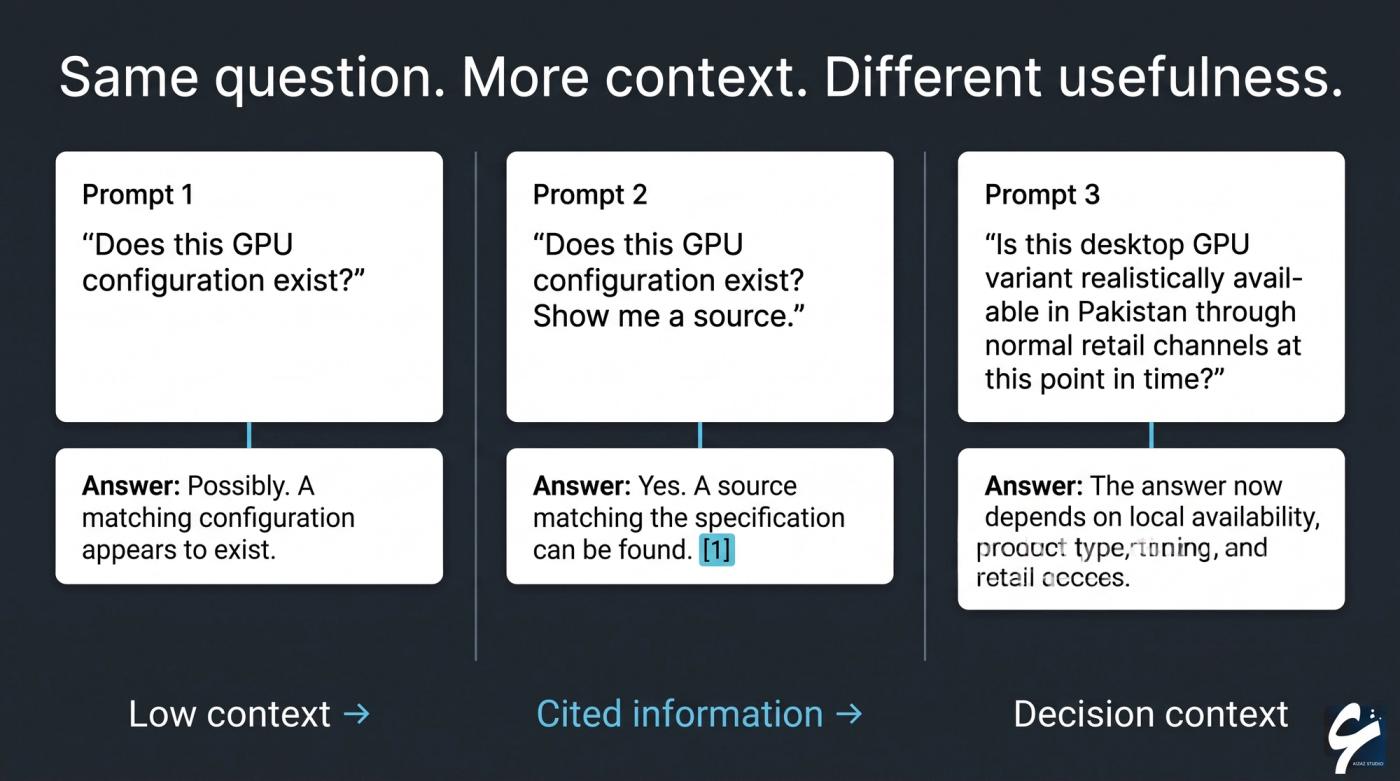
A while back, a customer came in asking about a very specific RTX graphics card configuration.
Something about it sounded off to me.
I knew what we were actually seeing through distributors, retailers, and the local market at the time, so I decided to double check it with AI.
The answer came back confidently.
According to the model, the configuration existed. More importantly, it had a citation to back that up.
At first glance, that should have settled it.
Except when I opened the source, it wasn't really answering the question I cared about. The evidence was coming from an obscure Chinese or international marketplace listing. Technically, the model had found something that matched the specification. It hadn't necessarily invented anything, and the citation itself wasn't necessarily fake.
But the customer standing in front of me wasn't asking whether that configuration had appeared somewhere on the internet.
He was effectively asking:
Is this a real option I can reasonably buy here?
Those are two very different questions.
That experience changed the way I think about AI answers, especially now that citations are becoming one of the things we use to decide whether an answer is trustworthy.
A citation can tell you where a fact came from.
It can't give the model context you never provided.
There are different ways for an answer to be “correct”
The AI had enough information to search for a matching product specification.
What it didn't have was everything sitting in my head when I asked the question.
It didn't know what products were commonly available in our market at that particular time. It didn't know whether I cared about something technically existing somewhere in the world or being realistically purchasable by a customer in Karachi. It didn't know whether an obscure international listing should count as meaningful availability.
To me, those details were obvious because I understood why I was asking.
To the model, they weren't part of the question.
That's a subtle distinction, but I think it's becoming increasingly important.
We tend to think about AI accuracy in terms of whether something is true or false.
Sometimes that isn't the actual failure mode.
An answer can contain true information and still be wrong for the decision you're trying to make.
If I ask whether a certain product exists, an obscure marketplace listing may be useful evidence but If I'm advising somebody standing in my shop about what they can realistically purchase, that same source could be practically useless.
The information didn't necessarily change the context around the decision did.
And once I started thinking about it that way, I noticed that businesses are starting to create the exact same problem for themselves with AI.
A business owner asks:
Can this process be automated?
In 2026, the answer to that question is increasingly likely to be yes.
AI can probably suggest a workflow. It can identify APIs. It might recommend an agent, an integration platform, some custom software, or a combination of all three. It can describe how data moves from one system to another and even help generate a large part of the implementation.
That can all be technically correct.
But imagine the process they're talking about happens twice a week and takes an employee ten minutes.
You've now asked AI a technical question when the real decision is economic.
Could we automate twenty minutes of weekly work?
Of course.
But somebody still has to understand the process, build the automation, handle exceptions, connect the systems, test it, monitor it, and eventually fix it when something upstream changes.
You can end up creating a permanent software responsibility to eliminate a tiny operational inconvenience.
Now take the same process and change the context. It happens hundreds of times every day, several employees are involved, errors regularly cost money, and every case follows almost the same set of rules.
The technology may be identical.
The decision isn't.
That's the part a generic prompt doesn't contain.
The quality of the answer starts before the prompt is sent
There is a lot of conversation around prompt engineering right now, and some of it makes using AI sound far more complicated than it needs to be.
I don't think most business owners need a 700-word master prompt.
What they need is a clearer description of the problem.
If I ask:
Should we automate invoice processing?
AI has to make assumptions about almost everything.
How many invoices?
How much time does it currently consume?
What format do they arrive in?
How consistent are they?
What software is being used?
How often does a person need to intervene?
What happens if the system gets one wrong?
Those details can completely change the recommendation.
Now compare that with:
We process around 30 invoices each week from recurring vendors. Most arrive as PDFs over email. One employee spends roughly six hours a week entering them into our ERP, and around 10% require clarification before they can be processed. Which parts are worth automating, where should a person remain in the loop, and what could make automation more expensive than leaving the process alone?
That isn't a magical prompt.
It's just a better explanation of the situation.
The AI now knows enough about the decision to give you something more useful than a list of technologies that could theoretically solve it.
This is the distinction I keep coming back to:
AI is very good at working with context. It is not very good at knowing which context you forgot to give it.
There are usually details inside a business that feel so obvious to the people running it that they never make it into the prompt.
Maybe half of your orders still arrive over WhatsApp.
Maybe a supplier sends spreadsheets that change format every other week.
Maybe a task sounds repetitive but actually requires judgment in a third of the cases.
Maybe a system you're using has no usable API.
Maybe someone already has to manually approve every output regardless of how much gets automated.
Or maybe, like the graphics card in my shop, something technically exists but isn't realistically available in the environment where the decision is being made.
Those aren't minor details.
Sometimes they're the entire decision.
Citations don't solve the context gap
I still want AI to cite its sources.
Being able to inspect where a claim came from is obviously better than accepting an unsupported answer.
But I think we have to be careful about treating citations as a substitute for judgment.
A citation can help answer:
“Where did this information come from?”
It cannot automatically answer:
“Does this information matter here?”
I've started thinking about the difference as a context gap.
On one side is everything the model knows from your prompt, its available information, and whatever sources it retrieves.
On the other side is everything you know about the real situation but never actually told it.
The wider that gap becomes, the easier it is to get an answer that looks excellent on screen and falls apart when you try to use it.
That matters even more for business decisions than it did for my graphics-card question.
If AI recommends the wrong GPU listing, you can open the source and notice something doesn't add up.
If it recommends building an automation, changing a workflow, selecting software, or redesigning a process, the cost of acting on an answer without enough context can be much larger.
This is also why, when somebody comes to us saying they want an AI agent, the first question shouldn't really be about the agent.
I'd rather understand what they're currently doing.
Where is the time actually going?
How frequently does the problem occur?
What are the exceptions?
What happens when something goes wrong?
What would a better outcome look like?
Once you understand that, you can start talking about technology.
Sometimes the answer really is an AI agent.
Sometimes it's ordinary software.
Sometimes it's connecting two systems that should have been connected years ago.
And sometimes the current manual process is already good enough.
That last answer isn't particularly exciting.
But it can still be the right one.
The same lesson applies when you're using AI yourself.
Ask for sources. Check them. Give the model enough information to reason properly.
But don't confuse an answer being well-supported with it being useful for your situation.
AI can find the right information.
It can cite the right page.
It can even be technically correct.
And if you haven't explained the decision behind the question, it can still give you exactly the wrong answer.